 Download
 Download
![[thumbnail of image 1.jpg]](https://reading-clone.eprints-hosting.org/82058/2/image%201.jpg "image 1.jpg")
![[thumbnail of image 2.jpg]](https://reading-clone.eprints-hosting.org/82058/3/image%202.jpg "image 2.jpg")
![[thumbnail of image 3.jpg]](https://reading-clone.eprints-hosting.org/82058/4/image%203.jpg "image 3.jpg")


Rodriguez-Mateos, A., Istas, G., Boschek, L., Feliciano, R. P., Mills, C. E.  ORCID: https://orcid.org/0000-0002-8313-3700, Boby, C., Gomez-Alonso, S., Milenkovic, D. and Heiss, C.
(2019)
Circulating anthocyanin metabolites mediate vascular benefits of blueberries: insights from randomized controlled trials, metabolomics, and nutrigenomics.
Journals of Gerontology Series A: Biological and Medical Sciences, 74 (7).
pp. 967-976.
ISSN 1079-5006
doi: 10.1093/gerona/glz047
ORCID: https://orcid.org/0000-0002-8313-3700, Boby, C., Gomez-Alonso, S., Milenkovic, D. and Heiss, C.
(2019)
Circulating anthocyanin metabolites mediate vascular benefits of blueberries: insights from randomized controlled trials, metabolomics, and nutrigenomics.
Journals of Gerontology Series A: Biological and Medical Sciences, 74 (7).
pp. 967-976.
ISSN 1079-5006
doi: 10.1093/gerona/glz047
Abstract/Summary
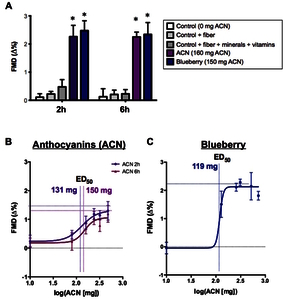
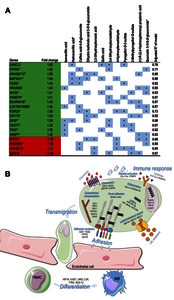
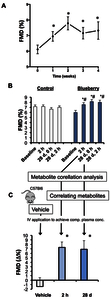
Potential health benefits of blueberries may be due to vascular effects of anthocyanins which predominantly circulate in blood as phenolic acid metabolites. We investigated which role blueberry anthocyanins and circulating metabolites play in mediating improvements in vascular function and explore potential mechanisms using metabolomics and nutrigenomics. Purified anthocyanins exerted a dose-dependent improvement of endothelial function in healthy humans, as measured by flow-mediated dilation (FMD). The effects were similar to those of blueberries containing similar amounts of anthocyanins while control drinks containing fiber, minerals, or vitamins had no significant effect. Daily 1-month blueberry consumption increased FMD and lowered 24h-ambulatory-systolic-blood-pressure. Of the 63 anthocyanin plasma metabolites quantified, 14 and 17 correlated with acute and chronic FMD improvements, respectively. Injection of these metabolites improved FMD in mice. Daily blueberry consumption led to differential expression (>1.2-fold) of 608 genes and 3 microRNAs, with Mir-181c showing a 13-fold increase in peripheral blood mononuclear cells. Patterns of 13 metabolites were independent predictors of gene expression changes and pathway enrichment analysis revealed significantly modulated biological processes involved in cell adhesion, migration, immune response, and cell differentiation. Our results identify anthocyanin metabolites as major mediators of vascular bioactivities of blueberries and changes of cellular gene programs.
Altmetric Badge
| Item Type | Article |
| URI | https://reading-clone.eprints-hosting.org/id/eprint/82058 |
| Identification Number/DOI | 10.1093/gerona/glz047 |
| Refereed | Yes |
| Divisions | Life Sciences > School of Chemistry, Food and Pharmacy > Department of Food and Nutritional Sciences > Human Nutrition Research Group |
| Publisher | Oxford University Press |
| Download/View statistics | View download statistics for this item |
Downloads
Downloads per month over past year
University Staff: Request a correction | Centaur Editors: Update this record
