 Download
 Download
![[thumbnail of Open Access]](https://reading-clone.eprints-hosting.org/101113/1.hassmallThumbnailVersion/Neto_etal_Amazon_drought_2021.pdf "Open Access")


Ribeiro Neto, G. G., Anderson, L. O., Barretos, N. J. C., Abreu, R., Alves, L., Dong, B.  ORCID: https://orcid.org/0000-0003-0809-7911, Lott, F. C. and Tett, S. F. B.
(2022)
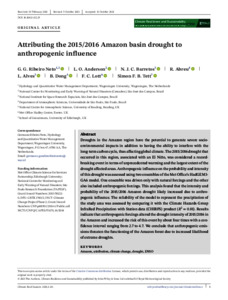
Attributing the 2015/2016 Amazon basin drought to anthropogenic influence.
Climate Resilience and Sustainability, 1 (1).
e25.
ISSN 2692-4587
doi: 10.1002/cli2.25
ORCID: https://orcid.org/0000-0003-0809-7911, Lott, F. C. and Tett, S. F. B.
(2022)
Attributing the 2015/2016 Amazon basin drought to anthropogenic influence.
Climate Resilience and Sustainability, 1 (1).
e25.
ISSN 2692-4587
doi: 10.1002/cli2.25
Abstract/Summary
Droughts in the Amazon region have the potential to generate severe socio-environmental impacts in addition to having the ability to interfere with the long-term carbon cycle, thus affecting global climate. The 2015/2016 drought that occurred in this region, associated with an El Niño, was considered a record-breaking event in terms of unprecedented warming and the largest extent of the drought affected areas. Anthropogenic influence on the probability and intensity of this drought was assessed using two ensembles of the Met Office's HadGEM3-GA6 model. One ensemble was driven only with natural forcings and the other also included anthropogenic forcings. This analysis found that the intensity and probability of the 2015/2016 Amazon drought likely increased due to anthropogenic influence. The reliability of the model to represent the precipitation of the study area was assessed by comparing it with the Climate Hazards Group InfraRed Precipitation with Station data (CHIRPS) product (R2 = 0.81). Results indicate that anthropogenic forcings altered the drought intensity of 2015/2016 in the Amazon and increased the risk of this event by about four times with a confidence interval ranging from 2.7 to 4.7. We conclude that anthropogenic emissions threaten the functioning of the Amazon forest due to increased likelihood of extreme droughts.
Altmetric Badge
| Item Type | Article |
| URI | https://reading-clone.eprints-hosting.org/id/eprint/101113 |
| Identification Number/DOI | 10.1002/cli2.25 |
| Refereed | Yes |
| Divisions | Science > School of Mathematical, Physical and Computational Sciences > NCAS Science > School of Mathematical, Physical and Computational Sciences > Department of Meteorology |
| Publisher | Royal Meteorological Society/Wiley |
| Download/View statistics | View download statistics for this item |
Downloads
Downloads per month over past year
University Staff: Request a correction | Centaur Editors: Update this record
